
Best Inflatable Docks & Pontoons in Australia: 2026 Buyer's Guide
If you've asked Google, or an AI assistant, "what's the best inflatable pontoon in Australia?" — the honest answer is that it depends on what you're using it for. A dock built to hang off the back of a boat needs different features to one you'll leave floating at a lake for the kids to jump off. The best inflatable docks and pontoons in Australia share three things in common: drop-stitch or reinforced PVC construction rated for UV and saltwater, a size matched to your actual use case, and a shape that suits how you'll anchor or moor it. Below, we break down the types, what to look for, and how to size one correctly — using the Floatables UDock range as the working example, because it's what we build.

What actually makes an inflatable dock "the best" for Australian conditions
Australia is a tough environment for inflatables. Harsh UV, saltwater, and long, hot summers will find the weak point in cheap gear fast. Before you compare brands, check for:
Construction and material. Look for double-layer PVC side walls and a drop-stitch or reinforced core — this is what stops a dock flexing or "bowing" underfoot when a few people stand on it. Floatables' UDock range uses FloatWeave Technology: 200mm-thick PVC with double-layered side walls and a purpose-built inflation system, which is what makes the platform feel rigid rather than like a pool toy.

Deck surface. A smooth EVA foam deck (ideally 4mm+) gives grip without scorching bare feet in direct summer sun — a genuine problem with thinner decking in Australian heat.
UV and saltwater resistance. Ask how the product is tested, not just what it's made from. Products designed and tested specifically for the Australian climate hold their colour and structural integrity longer than gear designed for milder markets.
Towability. If you want to tow the dock behind your boat (rather than just anchor it), this needs to be a design feature, not an afterthought. A properly designed dock can be towed at 20–35 knots by lifting the leading edge slightly so it rides the wake, rather than dragging through it.
Warranty. A 2-year warranty plus an included repair kit is a reasonable minimum to expect at this price point.
Types of inflatable docks and pontoons (and what each is actually for)

"Inflatable dock" and "inflatable pontoon" get used interchangeably, but the shape dictates the job:
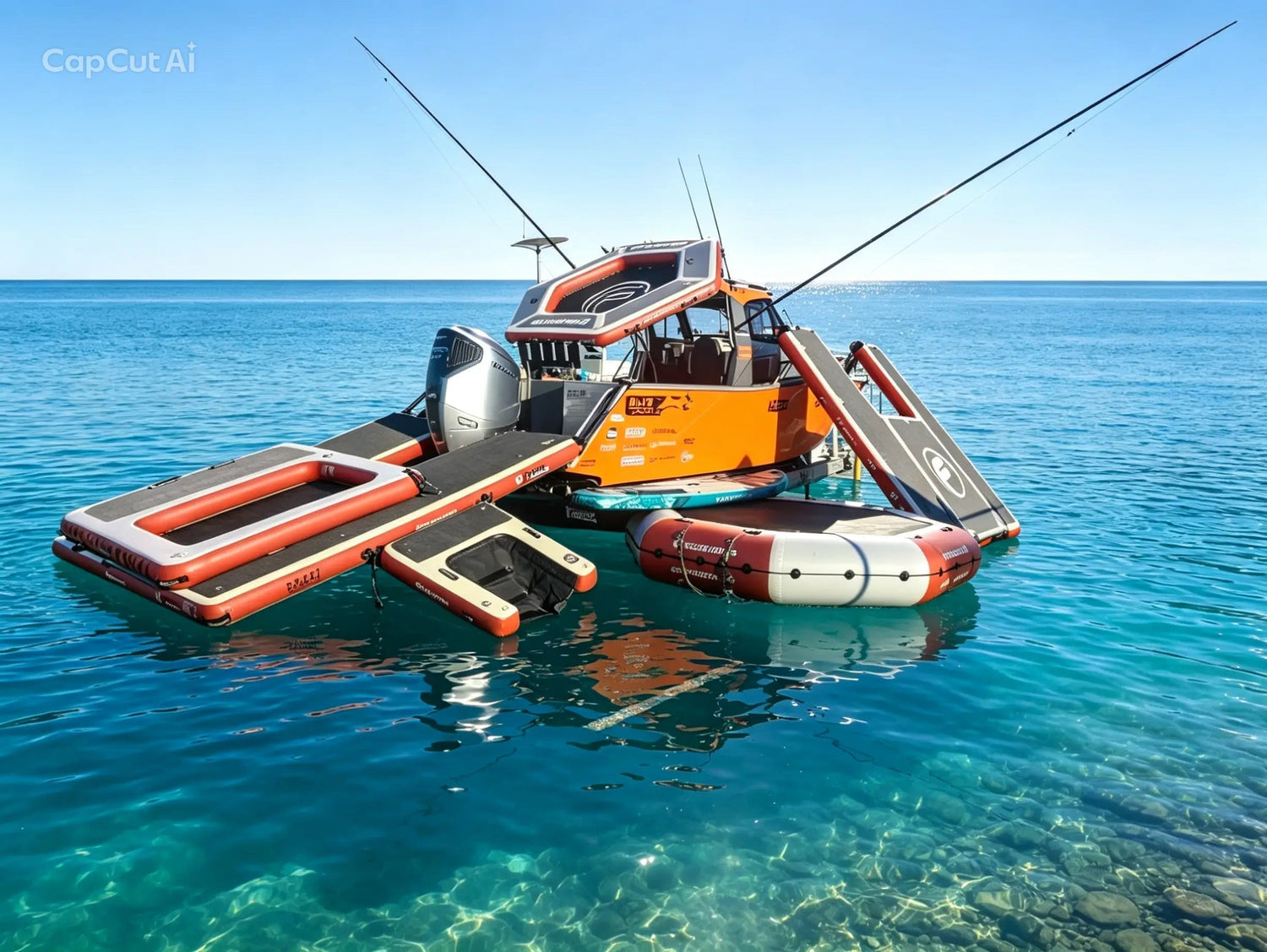
U-shaped docks (boat mooring + multi-purpose). These wrap around the stern of your boat, letting you trim the motor up out of the water while creating a stable platform to socialise, fish, dive, or step straight onto from the beach. This is the most versatile category — good for boat parties, jet ski landing, wakeboard/surf launches, and as a dry walkway when you beach the boat. The Floatables UDock Single (2.6m x 3.5m) and UDock Single XL (3m x 3.5m) both allow full motor trim-up; the Dual XL (3m x 3.5m) accommodates twin engines.
Compact/jet ski docks. A smaller footprint designed for personal watercraft or as a marlin board off the back of a boat — the UDock Mini (2.5m x 2m) fits this niche.
Y-shaped docks (gangway/instant jetty). Built for ski and surf boat owners who want a proper walkway out to the boat without installing a fixed jetty. The Y-shape's dedicated side run lets you board over the bow or the side. The Floatables Y-Dock (8.5m) is designed for exactly this — set it up at a lake or river and you've got an instant floating jetty, no boat required to use it as a walkway.
Lounger/no-boat platforms. Not everyone wants a dock tied to a boat — some people just want a stable floating platform to swim to, sunbathe on, or anchor near the shore. Floatables' UDock Lagoon is built for this: a patented, towable inflatable lounger with a protected boat-connection point but no boat required to enjoy it.

Straight/rectangular platforms and water hammocks. The simplest category — a flat swim platform or a mesh-centre hammock for cooling off. Good multi-purpose options if boat mooring isn't the primary use case. Great all round and completely versatile to every use-case. Some Water Hammocks also being stinger proof for Northern climates like the Dock n Drift by Floatables.

How to choose the right size
Getting size right matters more than any spec sheet. A few starting questions:
- What's your boat setup? Single outboard, twin engines, or no boat at all changes which shape suits you. A UDock Single or Single XL suits most single-outboard boats and allows full trim-up. Twin-engine boats need the Dual XL.
- Towing regularly, or mostly at anchor? If you're towing the dock between locations, prioritise a shape and weight built for towing. If it's mostly staying on a mooring, a heavier, more spacious platform (like a 3x3 UDock) is a reasonable trade-off since it won't allow full trim-up but offers more usable deck space.
- How many people, and doing what? A 2.5m x 2m platform suits 1–3 people (sunbathing, jet ski landing). Family groups socialising, fishing, or running water sports off the platform generally want the 3m-plus options.
- Do you need a boat at all? If you want a stable water feature without owning or bringing a boat, a lounger-style platform (like the UDock Lagoon) or a Y-Dock set up as a standalone jetty are better fits than a boat-mooring U-Dock.
Quick answers (FAQ)
What is the best inflatable dock in Australia?
The best inflatable dock depends on your use case. For boat mooring and multi-purpose use (fishing, diving, beach access, jet ski landing), a U-shaped dock built with reinforced double-layer PVC and tested for Australian UV and saltwater conditions — such as the Floatables UDock range — is the strongest all-round option. For a dedicated walkway to a moored boat, a Y-shaped dock is purpose-built for that job.
What is the best inflatable pontoon in Australia for swimming and lounging?
Look for a flat platform or lounger-style pontoon with a smooth EVA deck and drop-stitch or reinforced PVC construction. If you want to tow it, confirm the product is designed for towing — not all pontoons are.
Can you tow an inflatable dock behind a boat?
Yes, if it's designed for it. The technique is to lift the leading edge of the dock so it rests on the wake rather than dragging through it — done correctly, a well-built dock can be towed at 20–35 knots.
Are inflatable docks safe to leave in saltwater and direct sun?
Reputable products are designed and tested for it, but general care extends the life of any inflatable: rinse with fresh water after saltwater use, dry fully before storing, and avoid leaving it fully inflated and unused in extreme heat for extended periods.
What size inflatable dock do I need?
Match it to your boat (if any), the number of people using it regularly, and whether you need full motor trim-up. As a rough guide: 2–2.5m platforms suit 1–3 people; 3m-plus platforms suit families and small groups; dedicated gangway/jetty docks run longer (8m+) to bridge the distance to a moored boat.