
The Strongest Inflatable Dock in Australia? We Tried to Break Ours With a 30-Tonne Shipping Container
Floatables' inflatable dock and pontoon range is built to take more than everyday boat and swim use throws at it — so we set out to prove exactly how much more. We loaded our square 3m x 3m dock with pallets of steel, drove a forklift and a 4x4 on and off it, then landed a fully loaded 40ft shipping container weighing over 30 tonnes squarely in the middle of it, and drove a semi-trailer truck over the same dock. It didn't pop, tear, or lose pressure through any of it. Here's exactly what we did, and why it held.
Why We Set Out to Break It
"Heavy-duty" and "premium construction" get used on every inflatable dock product page in Australia, ours included. We wanted to know what our own claims were actually worth, so instead of writing about durability, we tried to physically destroy a dock and filmed the whole thing. If it survived, we'd have real proof instead of marketing copy. If it didn't, we'd know exactly where the construction needed to improve.
The Build-Up: Steel, Pallets, and a Forklift
We set the 3x3 Dock up on flat ground at its recommended operating pressure of 7 PSI, then started loading it by forklift — pallets of stock first, then cages of scrap steel. We worked through everything we could find around the warehouse, then went across the road to the steel workshop for more raw steel to keep piling weight on.
By the time we'd stacked 3-4 tonnes directly onto the platform — already double the rating we'd placed on it — it wasn't safe to keep adding weight by hand, so we switched to a 4-tonne forklift and drove it on and off the dock repeatedly, trying deliberately to pop or damage it. It held through every pass.

The 4x4 Bounce Test
Next we drove a 4x4 Isuzu D-Max onto the dock, bouncing it on and off repeatedly to load and unload the platform under real wheel weight and movement rather than a static load. Still no damage.
The Main Event: A 30-Tonne Shipping Container
At that point we knew the dock could handle more than a forklift, so we brought in a 40ft shipping container — one of our own factory containers, being delivered to us at the time, weighing more than 30 tonnes fully loaded. We positioned it over the dock twice, checking the alignment carefully both times to make sure the load sat evenly in the centre rather than off to one side, then lowered it directly onto the 3x3 Dock. The 40ft container balanced there, slowly rocking side to side, resting completely on the 3x3 pontoon. We filmed it from multiple angles. The dock held the full weight without tearing, popping, or losing pressure. Half of us stood back, and a few hid around corners, fully expecting it to blow.
Then We Drove a Semi-Trailer Over It
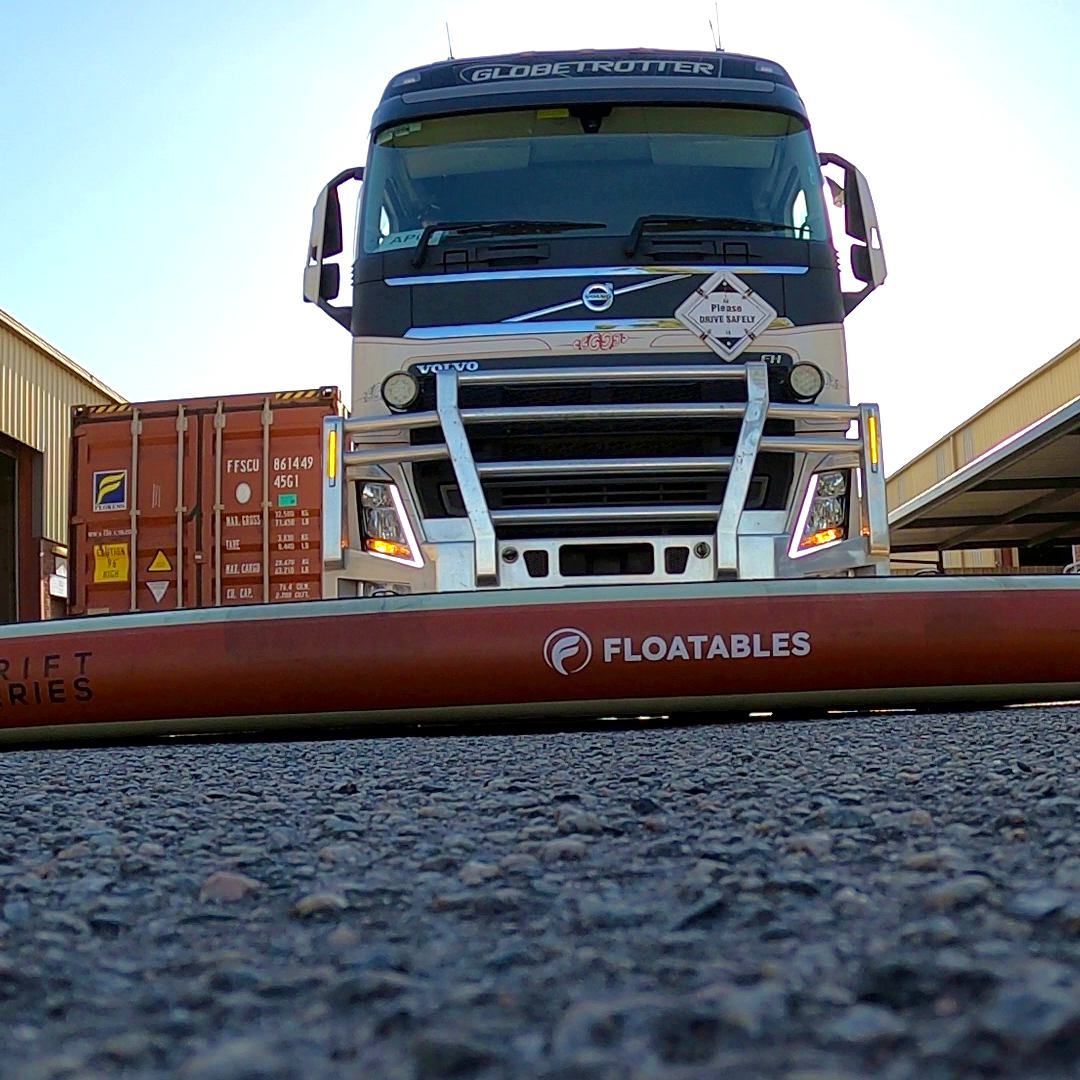
With the container test done, we set up a GoPro underneath the front of the dock, looking up, and drove a 40ft side-loader semi-trailer over the top of it. The footage shows the tyres pressing into the deck as the truck's full weight rolls across — and the dock springing back once the load passed. We followed that up with a mate from Fishin' Wishin' driving over the same dock while towing a boat, for good measure.

It Also Holds a Crowd
The container and truck tests were a deliberate, extreme stress test — proof of what the construction can survive, not a simulation of normal use. The more everyday question buyers actually ask is simpler: will it hold my group? At multiple Cold Nips and Raft Up events, we've had more people on a single dock than could physically fit standing shoulder to shoulder, and it's held every time without issue. We've got video and photos from several of those events too.

What Makes This Possible: FloatWeave Construction
None of this is possible on a standard single-layer inflatable. Every UDock is built with FloatWeave technology: 200mm-thick PVC with double-layered side walls and a purpose-built inflation system designed specifically for rigidity, not just buoyancy. The 4mm EVA foam deck sits on top for grip and comfort without compromising that structural strength. It's the same construction across the whole Floatables range — the 3x3 we tested isn't a reinforced one-off, it's built the same way as the complete range including our U-Dock Single, Single XL, and Dual XL.
What This Means for You
You're never going to park a shipping container on your dock, and you're unlikely to ever pack a crowd on as tight as we did at a Cold Nips event. But both extremes prove the same thing: the margin that survived 30 tonnes and held more people than could comfortably fit is what's underneath your boat, your jet ski, your mates, and an esky full of drinks on an ordinary day out. If it can take a semi-trailer, it will comfortably take everything a normal Australian summer throws at it — saltwater, UV, repeated loading and unloading, and years of use.
For the record: every test here was carried out deliberately by our team in a controlled setting, with nobody standing on the dock at any point. It's not something to try at home — it's there to show you what the construction can genuinely handle before it's ever carrying your gear.
Frequently Asked Questions
How much weight can a Floatables inflatable dock actually hold?
We tested a 3m x 3m dock well beyond normal use — including a 30-tonne-plus shipping container and a loaded semi-trailer driving over it — without any tearing or pressure loss. Normal use (boats, jet skis, groups of people) sits far below what the dock has already proven it can take.
What is FloatWeave technology?
FloatWeave is Floatables' construction method used across the whole UDock range: 200mm-thick PVC with double-layered side walls and a purpose-built inflation system for rigidity, topped with a 4mm EVA foam deck.
Was the dock damaged during any of the tests?
No. The dock was loaded incrementally with steel and pallets, driven over by a forklift and a 4x4, had a 30-tonne shipping container placed on it, and had a semi-trailer drive over it — it came through every stage without popping, tearing, or losing pressure.
Is this test representative of how I'll use my dock?
No — it's intentionally far beyond normal use. The point was to find the dock's actual limits under extreme deliberate stress, not to simulate everyday boating. Normal use is nowhere near this level of load.
What warranty comes with a Floatables dock?
All Floatables products come with a 2-year warranty and include a repair kit, on top of being designed and tested for Australian UV, saltwater, and freshwater conditions.
How many people can actually stand on a Floatables dock at once?
More than will physically fit. At multiple Cold Nips and Raft Up events, we've had docks loaded with more people than could comfortably stand shoulder to shoulder, and they've held without issue every time.
Click here for the indestructible Docks